
📦 Volumetric Weight vs Actual Weight: How Courier Parcel Weight Is Decided
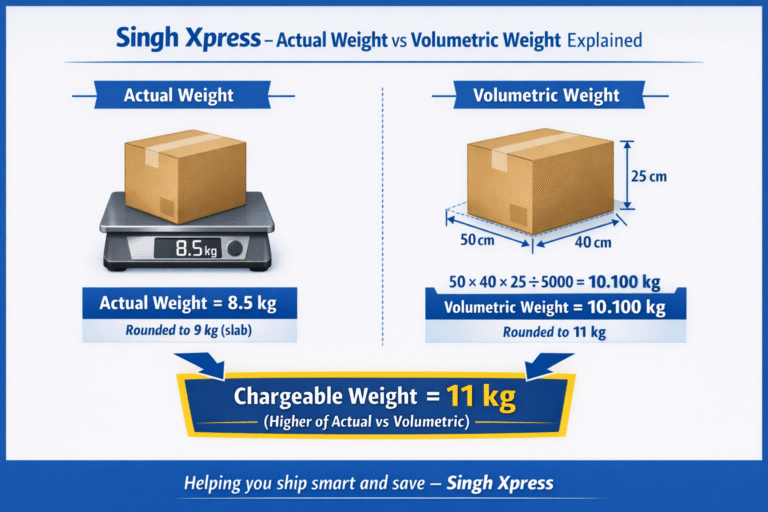
Many customers believe courier charges are based only on the actual weight of a parcel. In reality, courier companies decide the final billing weight using two different methods:
Actual Weight (Dead Weight)
Volumetric Weight (Dimensional Weight)
The higher of the two is always used as the chargeable weight.
Understanding this rule helps customers avoid confusion and unexpected courier charges.
⚖️ What Is Actual Weight (Dead Weight)?
Actual weight, also known as dead weight, is the physical weight of the parcel measured on a weighing scale.
Example:
Parcel weight on scale: 9.800 kg
Actual weight considered: 9.800 kg
After slab rounding → Charged as 10 kg
Actual weight is straightforward and depends only on how heavy the parcel is.
📐 What Is Volumetric Weight?
Volumetric weight is calculated based on the size (dimensions) of the parcel, not its physical weight.
It reflects the space the parcel occupies in an aircraft or vehicle.
✈️ Volumetric Weight Formula (Air / Express Courier)
Length × Width × Height (cm) ÷ 5000
📦 Volumetric Weight Example
Parcel dimensions:
50 × 40 × 25 cm
Calculation:
50 × 40 × 25 ÷ 5000 = 10.0 kg
If the carton size increases slightly:
= 10.100 kg
➡ Volumetric weight becomes 10.100 kg
➡ After slab rounding → Charged as 11 kg
🔁 How Courier Companies Decide Parcel Weight
Courier companies compare both weights:
Actual Weight
Volumetric Weight
👉 Whichever is higher is taken as the chargeable weight (after rounding to the next kg).
📊 Actual vs Volumetric Weight Comparison
| Weight Type | Measured Weight | Chargeable Weight |
|---|---|---|
| Actual Weight | 8.500 kg | 9 kg |
| Volumetric Weight | 10.100 kg | 11 kg |
| Final Billing Weight | Higher value | 11 kg |
Even though the parcel is physically lighter, it is charged based on volumetric weight.
❌ Common Customer Misunderstanding
Customers often think:
“My parcel is light, so charges should be low.”
However, large but lightweight parcels take up more space, which is why courier companies apply volumetric weight.
❓ Why Courier Companies Use Volumetric Weight
Volumetric weight is used because:
Aircraft and trucks have limited space
Bulky parcels reduce cargo efficiency
Airlines charge logistics companies based on space
It ensures fair and standardized pricing
This system is followed globally for domestic and international shipments.
💡 How to Reduce Courier Charges
Customers can reduce charges by:
Using smaller cartons
Avoiding unnecessary empty space
Reducing box height
Packing items tightly
Checking both weights before dispatch
At Singh International Xpress, we help customers optimize packaging to avoid higher volumetric slabs.
📌 Final Conclusion
Courier parcel weight is not decided only by actual weight.
Courier companies always charge based on:
Higher of Actual Weight or Volumetric Weight (after slab rounding)
So if:
Actual weight = 8.5 kg
Volumetric weight = 10.100 kg
➡ Final chargeable weight = 11 kg
Understanding this rule helps customers ship smarter, pack better, and avoid billing surprises.
📞 Singh International Xpress – Customer Support
📦 Need help calculating volumetric or actual weight?
📞 Call us: +91-9646555322 / +91-7986701081
📧 Email: support@singhxpress.com